The US wants its quantum lead to turn into factories and supply chains
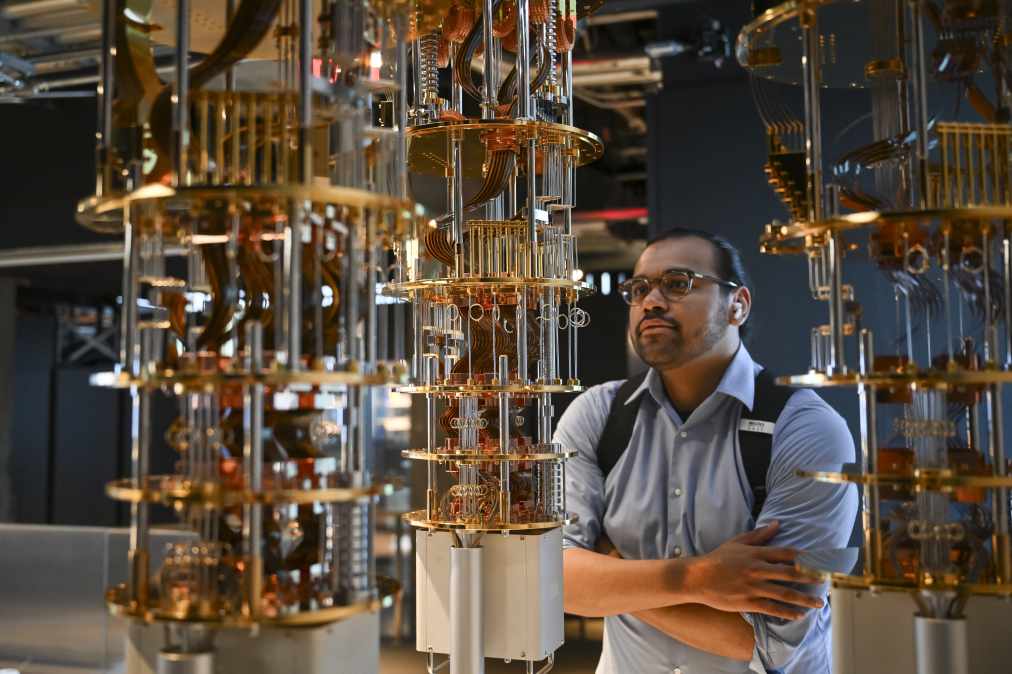
Policymakers from Congress and the executive branch are looking for ways to further boost the U.S. quantum computing industry, including by growing industrial capacity to translate scientific breakthroughs into workable technology.
Deputy Secretary of Commerce Paul Dabbar said the American industry is “by far the greatest leader in quantum technologies,” with a tech stack that is the envy of the world. The challenge will be translating those technological gains into real, brick-and-mortar industrialization and manufacturing dominance.
Dabbar pointed to other examples of federal support, such as grant funding from the CHIPS and Science Act and letters of intent signed earlier this year with nine companies investing more than $2 billion into different quantum technologies.
But one of the primary questions that Commerce officials ask companies when making decisions on federal investments is “How do we move a bit further down the road from discovery towards actually supporting individual technologies that can commercialize?” he said.
That question is being driven by U.S. assessments that the country’s quantum technology edge is real but is being threatened by countries such as China that have more robust industrial capacity.
Dabbar said the federal government is also attempting to follow its own example, citing White House executive orders on quantum computing and more aggressive timelines for agencies to migrate to quantum encryption, measures that CyberScoop was first to report last year. Commerce is the first agency scheduled to deploy its post-quantum encryption.
The department also has the authority to place export controls on technologies, as it did for Anthropic’s Mythos and Fable AI models earlier this year. Dabbar expressed caution but suggested Commerce officials were willing to use such controls to advance the interests of American technology makers.
“We have to be very careful about American leadership on the frontier on all technologies, and quantum is certainly one of them,” Dabbar said. “We want to be very thoughtful about making certain that which is invented by people in this room are retained by people in this room and are not copied or stolen.”
Dabbar’s comments came the same day that the Commission on U.S. Quantum Primacy released a report detailing the major challenges facing the American quantum industry.
The report warned that while research, software and private investment are “major strengths” for U.S. industry in its global competition with China, China’s manufacturing and supply chain production threatens to erode that edge.
“American scientific strengths may not translate into leadership in deployment and industrial production,” the report stated.
Boosting American industrial capacity in quantum is among the report’s top recommendations, including investments in physical infrastructure such as factories, foundries and suppliers that can “turn future breakthroughs into reliable systems.”
“To date, many quantum milestones have rightfully been measured in technical and scientific terms,” the report stated. “But national leadership requires a broader ambition: quantum primacy—the ability to turn scientific advances into sustained strategic advantage across quantum technologies.”
The commission is due to issue a final report in Spring 2027.
Sens. Ben Ray Luján, D-N.M. and Todd Young, R-Ind., served as co-chairs of the commission.
Meanwhile, Luján pointed to an alleged national security incident involving Nvidia CEO Jensen Huang as evidence that U.S. private industry can’t be trusted to protect America’s tech secrets. According to media reports Huang, who is married, had an affair with Chinese tech executive Alice Huang, later identified by U.S. intelligence agencies as a foreign intelligence asset working for China.
When asked about how to maintain U.S. competitiveness in quantum computing and other technologies, Luján said tech executives “need to be smarter” about protecting America’s tech secrets.
“People need to make better decisions when you’re entrusted with that kind of power and responsibility,” he said.
Luján, who did not mention Huang by name, said tech executives “know that other countries, they send people here to do bad things and get people locked up into telling secrets and things of that nature.”
“That clearly happens, and now we’re learning about it and the stock market’s reacting…don’t be stupid,” Luján said.
Luján said that while Democrats taking control of Congress will involve efforts to “push back” against executive branch overreach, he is open to working with the Trump administration and Republicans on legislation focused on the workforce and bringing “substantial investments across the United States in this space to ensure that the United States is going to stay in the front” of quantum computing.
But he suggested those investments could be wasted if Congress does not intervene with “good policy” and if tech executives can’t self-police their behavior. He pointed to another emerging technology, AI, where an innovation-at-all-costs approach has left industry poorly positioned to deal with cybersecurity and safety concerns.
“As we’re learning now from whistleblowers and others from some AI companies that we also need policy and guardrails, and the United States is qualified in a few [of those] areas,” Luján said.